Somebody told you your air conditioner runs on a refrigerant that’s being banned, and now you’re wondering whether the system in your side yard is about to become a paperweight.
Short version: no. R-454B refrigerant is the standard for new equipment, but your existing R-410A system is legal to own, run, and repair. EPA is explicit about it.
R-410A does get scarcer and pricier every year, which changes the math on an old, leaky system. Here’s what changed and what matters most: refrigerant is never consumed, so low refrigerant means a leak.
What is the new refrigerant for air conditioners?
R-454B, sold as Puron Advance or Opteon XL41. Some brands chose R-32. Both do the same job as R-410A with a fraction of the climate impact.
The driver is the American Innovation and Manufacturing (AIM) Act of 2020, which directs EPA to step hydrofluorocarbon production down to 60% of baseline for 2024 through 2028 and 15% by 2036. EPA’s Technology Transitions rule then capped new residential AC and heat pump refrigerants at 700 global warming potential, effective for manufacture and import January 1, 2025. R-410A’s GWP is about 2,088; R-454B is near 466. That gap is the whole reason for the change.
Does the R-410A phase out mean you have to replace your system?
No. This is the most misunderstood part of the R-410A phase out, and what dishonest sales pitches lean on.
EPA states there are no requirements to stop using equipment currently in use, and that you can keep it until the end of its useful life. You can keep repairing an existing AC or heat pump, including replacing a condenser or compressor. Parts used to repair existing systems aren’t subject to the GWP limit at all.
The rules also loosened rather than tightened. An earlier version required R-410A equipment built before 2025 to be installed by January 1, 2026; a final rule published May 26, 2026 removed that deadline, letting pre-2025 inventory be installed until supplies run out. One caveat: state rules can be stricter, and California runs its own HFC program through CARB. If you’re buying new equipment in Fresno or Clovis, have your contractor confirm what’s permitted.
The honest catch
Legal to service isn’t the same as cheap to service. Quotas keep stepping down and prices have climbed for years. Nationally, R-410A runs roughly $50 to $100 per pound installed, R-454B roughly $50 to $120.
R-22 shows where this goes: production ended in 2020, everything sold now is reclaimed from old systems, and prices soared. R-410A is on a slower version of that road. Your system isn’t obsolete, but a 14-year-old unit with a chronic leak loses value every year.
Which refrigerant is in my system, and how do I find out?
Go look. Ninety seconds, no tools.
- Walk to the outdoor unit, the box with the fan on top.
- Find the data plate, a foil or metal label on the side or back.
- Read the line marked REFRIGERANT or FACTORY CHARGE: R-22, R-410A, R-454B, or R-32.
- Photograph the plate. The model and serial numbers are what a technician asks for first.
Rough age guide: R-22 is 2010 and older, R-410A covers about 2010 through 2024, R-454B and R-32 appear on 2025-and-newer equipment. If sun has faded the plate past reading, common on west-facing Fresno installs, a technician can decode the serial number.
R-22 vs R-410A vs R-454B
R-22 | R-410A | R-454B | |
|---|---|---|---|
Status | Production banned since 2020 | New manufacture restricted since Jan 2025; existing stock installable | Standard for new equipment |
Safety class | A1 (non-flammable) | A1 (non-flammable) | A2L (lower flammability) |
GWP | ~1,810 | ~2,088 | ~466 |
Typical systems | 2010 and earlier | Roughly 2010–2024 | 2025 and later |
Service outlook | Reclaimed only; expensive | Serviceable indefinitely; prices rising | Widely available |
Is R-454B refrigerant dangerous? What A2L really means
R-454B is classified A2L: “A” for lower toxicity, “2L” for lower flammability with a low burning velocity. It isn’t inert, and “mildly flammable” is accurate. It also isn’t gasoline in your side yard. Testing behind the classification shows substantial effort is needed to start ignition and sustain it; an A2L burns slowly and tends to self-extinguish.
Equipment matches. A2L systems include leak detection as standard, shutting the compressor down and running the blower to disperse vapor before it concentrates. Real risk in a properly installed, properly charged system is low. What matters is installation quality, so care who handles your AC installation in Fresno.
Low refrigerant always means a leak
Refrigerant is not fuel. It circulates in a sealed loop and is never consumed. A system charged correctly should hold that charge for life.
So when someone says your system is “low on refrigerant,” the right question is where is it going. Adding refrigerant without finding the leak is a rental, not a repair: you pay to release that charge into the atmosphere over a season, then pay again next summer. Some companies build a business model on that annual top-off. We won’t quote one.
Symptoms that point to a refrigerant leak
What you notice | What’s likely happening |
|---|---|
AC blowing warm air on a 105-degree afternoon | Charge too low to move heat |
Frozen AC coil: ice on the coil or copper line | Low charge drops the coil below freezing |
Hissing or bubbling near the indoor unit | Refrigerant escaping a pinhole |
Runs constantly, never satisfies the thermostat | Reduced capacity from a partial charge |
Act fast on ice. A frozen AC coil can send liquid refrigerant back to the compressor, and compressor failure turns a manageable repair into a whole-system decision. Shut it off, run the fan to thaw, and call. Our AC repair guide for Fresno and Clovis covers the rest.
What refrigerant leak repair costs
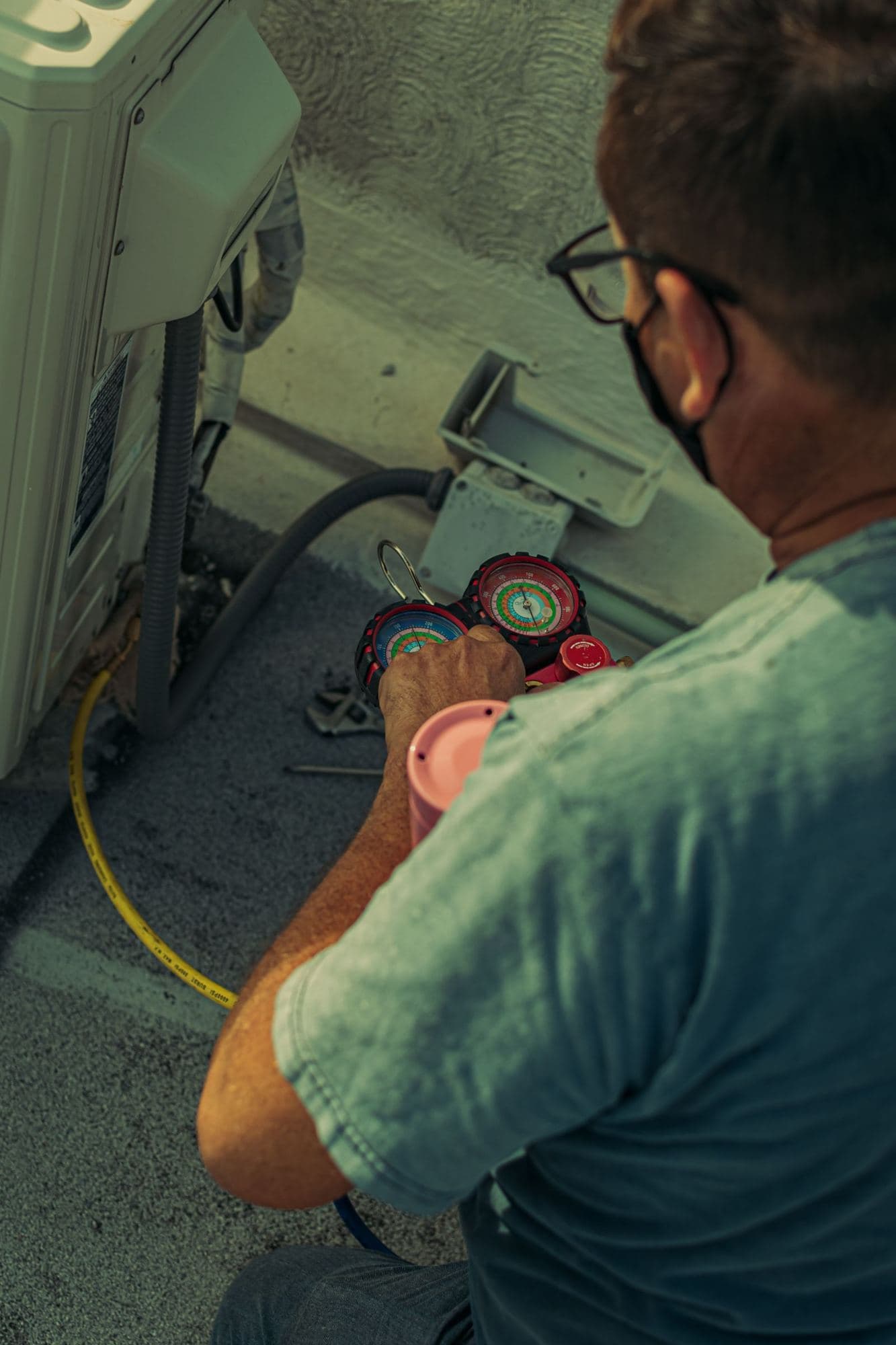
It depends where the leak is, and nobody can tell you over the phone. Proper refrigerant leak repair starts with locating it using an electronic sniffer, UV dye, or nitrogen pressure test. Nationally, detection runs about $100 to $330. From there:
- Line set, valve, or accessible fitting: the cheapest outcome. Repair, evacuate, recharge.
- Condenser coil: nationally about $900 to $2,300 to replace.
- Evaporator coil: roughly $1,000 to $2,500 under warranty, $2,500 to $4,500+ without.
Central Valley labor sits near the high end of those ranges, and your real number needs an in-home assessment. Anyone quoting a coil replacement sight unseen is guessing. When an evaporator coil fails on an R-410A system past twelve years old, replacement is often the better money; at year five, it isn’t.
Catching leaks early is most of the game, which is why pressure and superheat checks belong in what a real AC tune-up includes.
Talk to someone who’ll find the leak
If your system is short on refrigerant, you deserve to know where it’s going before anyone puts a gauge on it. We find the leak, price the fix, and say plainly when repairing an aging R-410A system stops making sense. No top-off contract, no scare pitch. Call Innovative Heating and AC at 559-832-6540.